
BEIRUT / 2026
BEIRUT / 2026
Deep Roots: From Captivity to Diaspora
Details of Daily Life: Customs and Practices in the Heart of Beirut
Deconstructing Concepts: Religion, Nationalism, and Politics
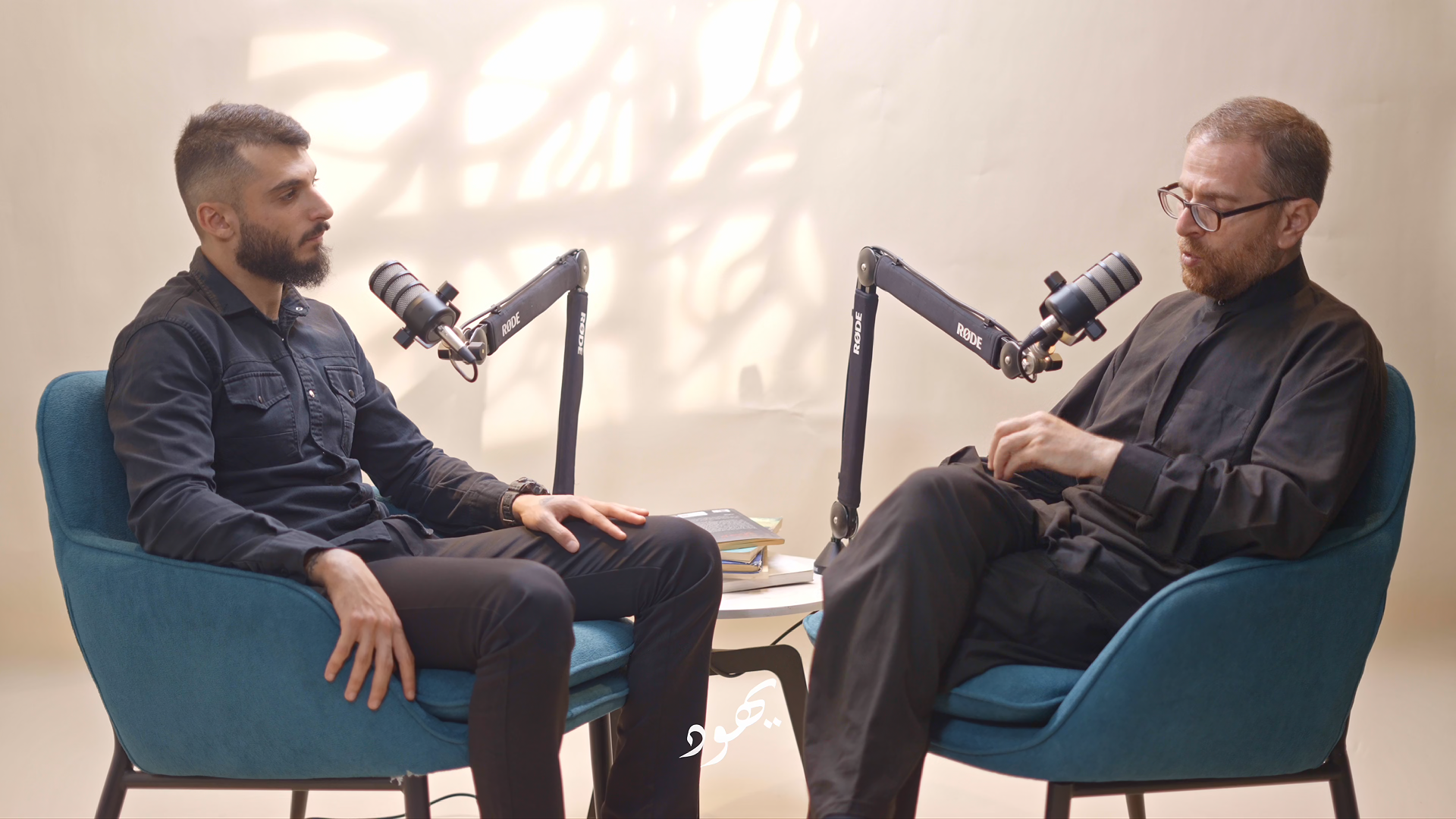
If long history explains the geographical spread and cultural diversity of the Jews, the present cannot be understood without deconstructing the fundamental concepts that have become entangled over time and become a primary cause of confusion in the perception of Jewish communities in the Arab region. Here comes the approach of Dr. Hussein Obeid, who starts from a point he considers essential for understanding everything that follows: the methodological "confusion" between fundamentally different concepts.
Discussing the Jews, as Obeid says, cannot be done without making a precise distinction between three distinct layers: the Children of Israel, Judaism, and Zionism. The Children of Israel are a people, a human group tracing its lineage to the Prophet Jacob, who is also called Israel. Judaism is a religion, the law of the Prophet Moses, with all its rulings, creeds, rituals, and practices. Zionism, on the other hand, is a modern political project born in Europe at the end of the nineteenth century, aiming to establish a national homeland for the Jews in Palestine.
This distinction is not a theoretical academic detail, but a fundamental key to understanding everything that follows in the relationship between Arab societies and Jewish communities.
But the problem, according to Obeid, is that this logical distinction has not been respected in political, media, and popular discourse. The Zionist project, which emerged in Europe as a fundamentally secular movement, did not content itself with adopting a political and territorial discourse; it also drew upon the Jewish religious heritage to grant itself religious and historical legitimacy. Concepts such as "the chosen people" and "the Promised Land," which were originally theological-religious concepts, ceased to be mere internal beliefs and were transformed into political tools in service of a settler-colonial project.
Hence emerged slogans such as "A land without a people for a people without a land," which formed the basis for a complete political narrative that ignored the existence of the indigenous population in Palestine.
These slogans, as Obeid explains, were not born in a vacuum, but were part of a broader colonial context in the nineteenth century, in which knowledge about the East and its people was reproduced in ways that served European colonial projects.
Obeid notes that these ideas did not begin with the Balfour Declaration of 1917; they were preceded by several attempts, some dating back to Napoleon Bonaparte, who considered establishing a homeland for the Jews in Palestine during his campaign in Egypt and Syria, all the way to later European projects at the Basel Congress and others. These repeated attempts reflect, according to Obeid, the depth of the connection between the Zionist project and European colonialism, rather than what is promoted as a national liberation movement for an oppressed people.
In this context, Obeid introduces the concept of "settler colonialism," which aims not only to control land and exploit its resources, but to replace its indigenous population with others. This is what distinguishes the Zionist case, according to him, from other forms of traditional colonialism. This colonialism is not content with political domination but works to fundamentally change the demographic, demographic, and cultural composition.
This systematic entanglement of religion and politics did not remain theoretical or academic. It was directly reflected in the societies of which Jews were a part, including Lebanon, where the image of "the Jew" gradually began to change in public consciousness.
The Jew was no longer seen as a citizen belonging to a particular religion within Lebanon's pluralism but began to be transformed in the popular imagination into a symbol of a hostile external political project, placing the local Jewish community in a difficult position for which it paid a heavy price.
Lebanon: A Functional Relationship More Than a Confrontational One
In Lebanon, the story does not begin with religious conflict or sectarian animosity, but quite the opposite. Dr. Marwan Abi Fadel explains that the relationship between the Jews and other Lebanese sects, particularly Christians, was not based on hostility or tension, despite the existence of global theological backgrounds that might suggest otherwise. This unique relationship constitutes an important model for understanding Lebanese pluralism in its various dimensions.
In Europe, the image of the Jews was associated for centuries with heavy religious accusations, including the matter of the crucifixion of Christ, which placed them collectively in the position of the accused, as well as various accusations of killing children and using their blood in rituals, creating a deep historical tension between Jews and Christians in the West. But in Lebanon, the picture is completely different, and the relationship took another path.
The reason, as Abi Fadel explains, goes back to the Ottoman system based on the "millets," which granted each religious community space to manage its internal affairs within a framework of official recognition of pluralism. This system did not abolish religious or doctrinal differences between sects, but it prevented them from turning into direct confrontation, especially in the absence of a unifying religious authority imposing a single creed on everyone.
In Lebanese villages, there was hardly any daily contact worth mentioning between Muslims or Christians on one hand and Jews on the other, simply because Jews were not noticeably present there.
ation the safest option for them and their families.
The Jewish population concentration was in the cities, where they had been present for centuries. In the countryside and mountains, their presence was almost non-existent. But in the cities, where they were present, a different relationship emerged that reflected the reality of Lebanese pluralism.
In Beirut, Sidon, and Tripoli, the Jews were an active part of the economic and social movement. They met Christians and Muslims in the markets, in the liberal professions, in local and international trade. "The relationship was functional," says Abi Fadel, meaning based on shared daily interests and continuous exchange. A merchant sells his goods, a customer buys them, an artisan offers his service, a client pays for it... without religious doctrine being the primary or sole determinant of the relationship between people.
But this social and human image gradually began to change with the region's major transformations.
After 1948, Jews were no longer seen merely as a local religious community but began to be associated with a foreign political project embodied by Israel. With the 1967 war, this transformation deepened in the collective consciousness, and the relationship became increasingly governed by suspicion and apprehension, losing much of its functional daily nature.
Then came the Lebanese Civil War (1975-1990), which accelerated what had begun years earlier, causing the Jewish presence to visibly and tangibly decline until it became merely a memory in old Beirut neighborhoods.
The war that tore apart the Lebanese social fabric along sectarian lines did not spare the Jews, who found themselves between the hammer of internal conflicts and the anvil of regional tensions, making emigr
From the Mountain to Wadi Abu Jamil:
The destination was clear: near the port, where commercial activity and markets were concentrated. In the commercial heart of the capital, something resembling a "Jewish quarter" took shape in the Wadi Abu Jamil area, which became synonymous with Jewish presence in Beirut. This neighborhood was not merely a place of residence, but a complete center of life: synagogues for prayer, schools for educating children, shops for trade, cafés for social gatherings. In the street, you could hear multiple languages: Arabic, Hebrew, French, Italian, and Turkish. You could see small shops selling everything and observe a natural life unfolding like any other Beirut neighborhood. The Jews were not all wealthy, as is sometimes rumored in popular narratives. Among them were large and small traders, skilled artisans, public and private sector employees, and even simple workers. The class diversity within the Jewish community reflected the class diversity in Lebanese society at large, with clear economic disparities between families. But with the rise of the Zionist project and increasing tensions in the region, Jewish emigration from Lebanon began to escalate. Some left out of conviction and affiliation with the new state, some left out of fear for the future, and some left in search of better economic opportunities. Then came larger events: 1948 and the establishment of Israel, 1967 and the war, leading up to the civil war, which was the last straw. "Here everything changed," says Awada, as emigration was no longer an individual or family choice, but transformed into an organized collective wave. Houses were closed one after another, shops were emptied of their goods, and the neighborhood began to lose its spirit and pulse. Today, the buildings of Wadi Abu Jamil stand silent, carrying the memory of a community that lived here, worked, and left its mark, before it faded away and became merely an address in the pages of Lebanese history.
Economics Charts the Path
If we want to see the Jews in Lebanon in a tangible and material way, we must turn to geography, where maps chart the course of human communities and reveal their transformations over time. Here, Dr. Mohamed Awada presents a vivid and detailed picture of the Jews' movement within Lebanon, from the high mountains to the Mediterranean coast, in a journey reflecting major economic and political transformations.
Initially, the Jews were present in mountainous areas such as Deir al-Qamar in Mount Lebanon. There, they built their synagogues from the seventeenth century onward and had a clear religious and social presence in this historical region, which included remarkable sectarian diversity. But the major transformations of the nineteenth century changed everything and reshaped Lebanon's demographic map entirely.
The events of 1860, which witnessed bloody sectarian clashes in Mount Lebanon, and then the opening of the Suez Canal, which redirected global trade routes all these factors shifted the economic center of gravity toward the Lebanese coast.
Beirut began to grow and expand, becoming a vital commercial and financial center connecting East and West, attracting populations from the interior and mountainous regions.
With this major economic transformation, the Jews began to move from the mountain to the coast. They gradually left Deir al-Qamar and other mountain villages and headed toward the rising city.
Details of Daily Life: Customs and Practices in the Heart of Beirut
Away from politics and major transformations, there was a simple daily life representing the human essence of the Jews' presence in Lebanon. Dr. Salim Mansour describes this life in almost intimate detail, reflecting the reality of daily coexistence far from the political and media propaganda that dominated the public image.
In some old buildings in Beirut, a Muslim lived on one floor, a Christian on another, and a Jew on a third.
During Ramadan, the Jews would refrain from eating and drinking in public out of respect for fasting Muslims. On Christian holidays, they would exchange greetings with their neighbors. And on Jewish holidays, they would welcome neighbors into their homes. This is not an idealized or oversimplified image, but a reality documented in the records of the Sharia courts, where contracts, acknowledgments, and testimonies show daily cooperation between people of different sects.
The Jews did not live in social isolation; they were active members of civil society.
They worked in local and international trade, in medicine where some excelled in various crafts, and some even oversaw matters directly related to the community, such as ritual slaughter or medical practice. Some Jewish physicians treated patients from all sects without discrimination and enjoyed high levels of trust and respect. In the educational field, the Jews established their own schools to teach their children their language and heritage, but they also studied in shared schools with children of other sects, and they had a clear presence in Lebanese educational and cultural life. Some Jewish intellectuals and writers left their mark on Lebanese journalism, literature, and thought, despite their limited numbers. This practical coexistence was not only a Lebanese exception; it was part of a broader context in the Ottoman Empire, which received European Jews after their persecution in Europe and provided them with spaces to live and work within the millet system. The Sephardic Jews who came from Andalusia and Spain, and the Ashkenazi Jews who came from Eastern Europe, found in the Ottoman Empire a more tolerant environment than they had experienced in their former homelands. But, as in the entire Lebanese story, this natural reality did not last long in the face of major political transformations. The Cold War began to pull the region into new conflicts, and the Arab-Israeli conflict began to draw new boundaries of belonging and loyalty, until Jewish presence in Lebanon became a political issue more than a social or religious one.
Rituals of Life and Death: The Human Face
with Dr. Talib Qara Ahmad In the small details of daily life, the true human image emerges, away from grand headlines. Dr. Talib Qara Ahmad sheds light on aspects of the daily life of Lebanese Jews, revealing the depth of their religious commitment and the details of their practices that shaped their distinctive identity within the broader Lebanese society. In the economy, some Jews practiced lending with interest, especially during times of economic crises that periodically afflicted Lebanon. This was part of the familiar economic reality, where people resorted to borrowing and putting up collateral in exchange for money. This profession, which was prohibited in Islam but permitted in Judaism, led some Jews to excel in this field, though they were not the only ones who practiced it in multi-sectarian Lebanon. But within their own community, there were different economic rules, more flexible and less exploitative, reflecting special internal solidarity bonds. Loans between Jews themselves were often interest-free, or with a nominal interest, in practical application of religious teachings that encourage internal solidarity among members of the same community. In death, the religious rituals appear more clearly and more systematically organized. When a member of the Jewish community dies, the body is washed according to specific rituals, shrouded in simple white garments, then buried quickly—often before noon of the same day or the next day at the latest. The body is oriented toward Jerusalem, a clear religious indication of the spiritual orientation toward the holy city—an orientation not unlike Muslims facing Mecca in their prayers and burials. Even the smallest details carry deep meaning in Jewish rituals: placing water in the deceased's mouth as a symbol of purity, washing the body in a specific way by specialists, the speed of burial reflecting a religious conception of life, death, and transition to the afterlife. All these details reflect an integrated understanding of human existence, where every step is calculated and connected to faith. In Lebanese cities like Sidon, the old cemeteries still bear witness to this historical presence. Silent graves, but they carry names that were once part of this land, families that lived here and left their marks before leaving. Some of these graves are still visited by Jewish families who emigrated but retain the memory of their ancestors in Lebanon.
Society and Religion:
A Complex Relationship with the Surroundings
The story of the Jews in Lebanon cannot be understood without placing it in its broader social and religious context. The relationship between the Jews and other sects was not one-dimensional but complex and intertwined, influenced by multiple factors: religious, economic, political, and cultural.
Religiously, the Jews formed a small minority within a Lebanese sectarian system based on official recognition of sects. This system, which Lebanon inherited from the Ottoman Empire, gave each sect space to manage its internal affairs but also entrenched boundaries between sects and made religious affiliation fundamental to political and social life. In this context, the Jews were a recognized sect, with their own religious courts and institutions, but they were the smallest in number and influence.
Economically, the Jews played a role in trade, finance, and the liberal professions—fields that allowed them to interact with all sects.
These economic relationships were vertical and horizontal, bringing them together with Muslim and Christian merchants, and creating networks of shared interests that often transcended sectarian boundaries.
Culturally, there was exchange and mutual influence. Arab culture was the general framework in which Lebanese Jews lived; they spoke its language and participated in its literature and arts. In return, the Jews had an influence in some fields, especially music, medicine, and trade, where some excelled and left clear marks.
But this social and economic integration did not prevent the existence of anti-Semitic currents, though they were limited compared to Europe. Some religious and political discourses carried tones of animosity, especially during periods of regional tension, but they did not turn into state policy or systematic persecution as happened in the West.
The Nakba and Transformation: From 1948 to the Civil War
The major turning point in the history of Lebanese Jews was 1948, with the establishment of the State of Israel and the subsequent war.
This event, which was a watershed moment in the entire region's history, placed Lebanese Jews in a difficult position between their religious identity and their national belonging.
Before 1948, Lebanese Jews were part of the national fabric, participating in political and economic life, representing a sect among the recognized Lebanese sects. Some held public office, participated in national movements, and lived their daily lives like any other Lebanese citizen.
After 1948, perceptions of Jews changed, and doubts began to arise about their loyalty to the nation. Were they Lebanese first, or was their loyalty to the new state? This question became central to Lebanese society's relationship with the Jews, and pressures began to mount on the Jewish community to choose between two identities that had become contradictory in the Arab-Israeli context.
With the 1967 war, this division deepened, and Arab nationalist sentiments that absolutely linked Jews to Israel escalated. During this period, a collective emigration of Jews from Lebanon began, some to Israel, some to Europe and the Americas, and some to other Arab countries.
Then came the Lebanese Civil War (1975-1990) to be the final station of Jewish presence in Lebanon. Amid the chaos and sectarian fighting, the Jews became an easy target for all parties, even though they did not participate in the fighting. Some were kidnapped, others threatened, and many had their property stolen. During this bloody period, most of the remaining Jews left Lebanon, their synagogues were closed, and their neighborhood became a semi-abandoned area.
Today, only a very small number of Jews remain in Lebanon, mostly elderly people who did not leave, and their Jewish community has become merely a memory in old Beirut neighborhoods.
But their traces remain visible in architecture, history, and the collective memory of Lebanese people.
Wadi Abu Jamil: A Silent Witness to a Living History
Wadi Abu Jamil neighborhood in Beirut is the most prominent witness to this historical presence. This neighborhood, which was the center of Jewish life in Lebanon, carries within its walls many stories, daily life, dreams and hopes, before it turned into a semi-abandoned area bearing the marks of neglect and forgetfulness.
The neighborhood's buildings still stand, some dating back to the nineteenth and early twentieth centuries, with beautiful architectural styles combining Ottoman and European influences. The main Jewish synagogue in the neighborhood still exists, but has been closed for decades, guarded by the Lebanese army at times, while attempts to revive Beirut's heritage seek to restore the site as a heritage location.
In Wadi Abu Jamil, there was a vibrant life. Cafés frequented by Jews and others, shops selling everything from food to clothing to jewelry, schools for educating children, synagogues for prayers on holidays, and headquarters for charitable and cultural associations. The neighborhood was bustling with life, especially on Saturdays and Jewish holidays.
Today, the neighborhood has largely transformed into a commercial and industrial area, with some old residential buildings remaining that house Lebanese families from other sects. But the neighborhood's spirit has changed, and the living memory of its Jewish presence has faded. Visitors today do not know much about the neighborhood's history, except through books, articles, and rare testimonies.
Attempts to restore and revive Wadi Abu Jamil began in recent years, by the Municipality of Beirut and some heritage organizations. But these attempts face major challenges: lack of funding, absence of political will, and the difficulty of reviving a memory no longer alive in Lebanese collective consciousness.
Jewish presence in Lebanese memory is not uniform, but ranges between total forgetfulness and emotional remembrance, between denial and acknowledgment. This disparity reflects the contradictions of Lebanese society itself and its relationship with its complex history.
On one hand, there is official forgetting of Jewish presence in Lebanon. School curricula do not mention Jews except in the context of the Arab-Israeli conflict, as part of the external enemy, without indicating that they were once part of the Lebanese fabric. Lebanese media also rarely address the history of Jews in Lebanon, except in limited heritage programs or academic articles.
On the other hand, there is personal and family remembrance of this presence. Many Lebanese families, especially Christians, have memories of Jewish neighbors, colleagues, or business partners. These memories are often positive, carrying a tone of nostalgia for a time when coexistence was possible. Some of these families preserve old photographs, letters, and stories about the Jews who lived among them, shared holiday meals with them, and exchanged visits on occasions. These personal memories carry a warmth not found in history books, and form part of Lebanese oral heritage that is fading with the passing of older generations.
On a third hand, there are those who deny or ignore this presence for political or ideological reasons. In this context, Lebanese Jews are viewed as part of the Zionist project, and their distinction as citizens who lived in Lebanon for centuries is erased. This denial, despite its strength in some circles, contradicts historical facts documented in court records, Ottoman and French archives.
On a fourth hand, there is academic and research remembrance, carried out by Lebanese and foreign historians and researchers seeking to document this unique experience before it completely disappears. These academic works, though few in number, constitute an important reference for understanding the history of Jews in Lebanon away from political and religious biases.
In recent years, Lebanese voices have begun to emerge calling for re-recognition of this history and considering it part of Lebanon's diverse heritage. Some of these voices call for restoring Jewish synagogues and converting them into museums or cultural centers, as a reminder that Lebanon was once a homeland for everyone, and that its pluralism was not limited to Islamic and Christian sects alone.
But these calls, despite their symbolic value, face major challenges on the ground: lack of funding, absence of political will, and the complexities of the current Lebanese situation that preoccupies everyone with concerns other than heritage and history.
The story of the Jews in Lebanon is a story of absent scars that continue to affect the Lebanese mosaic. It is a story of a community that lived within a diverse fabric, contributed to economic and social life, before regional transformations drove it to decline and emigration. Today, their presence is no longer as visible as it once was, but their traces remain present in the buildings, in popular memory, and in unresolved questions:
How can this history be read away from oversimplification, preserving its accuracy and complexity simultaneously? And can Lebanon today, amid its successive crises, absorb this part of its history and re-acknowledge it?